
Hospitality Law Glossary
Build your understanding of the language of hospitality law with this comprehensive glossary of legal, insurance, risk management, employment, and industry-specific terms. Use it as a practical reference for navigating the terminology and concepts that shape the hospitality industry. Updated August 2026
A:
ABANDONED PROPERTY
Personal property that has been deliberately put aside by the rightful owner with no intention of ever returning for it.
Context: Common in hotels with lost and found items.
ACCEPTANCE
Unconditional agreement to the precise terms and conditions of an offer, forming a binding contract.
Context: Essential in booking confirmations and service agreements.
ACTUARY
A mathematician or statistician who computes insurance risks and establishes premium rates.
Context: Hospitality businesses work with actuaries for liability insurance pricing.
ADHESION CONTRACT
A contract whose terms were not truly negotiated or bargained and may be so one-sided in favor of the stronger party that courts may deem it unenforceable.
Context: Common in guest waivers and terms of service.
AFFIRMATIVE ACTION
A Federally mandated requirement that employers meeting certain criteria must actively seek to fairly employ recognized classes of protected workers. Some state and local legislatures have also enacted Affirmative Action requirements.
Context: Hotels and restaurants must comply with federal employment discrimination laws.
AGENT
A person authorized to act for or represent another party, usually referred to as the principal.
Context: Travel agents, booking agents, and corporate travel coordinators.
AGGREGATE
The maximum total amount an insurer will pay for all claims during a policy period.
Context: Essential to understand aggregate vs. per-occurrence limits in liability insurance.
AMERICANS WITH DISABILITIES ACT (ADA)
Federal legislation protecting the rights of people with disabilities, ensuring fair workplace treatment and access to public accommodations such as hotels, restaurants, and transportation.
Context: Hospitality venues must provide accessible facilities and reasonable accommodations.
AMUSEMENT PARK
An entertainment facility featuring rides, games, food, and entertainment shows. Theme parks center attractions around a central theme or themes (e.g., Disney, Universal Studios).
Context: Subject to specific liability and safety regulations.
ANNUITY
Fixed payments made on a regular basis for an agreed-upon period or until the death of the recipient.
Context: Used in executive contracts and deferred compensation packages.
APPEAL
A written request to a higher court to modify or reverse the decision of a lower-level court.
Context: Important remedy when losing a hospitality-related lawsuit.
ARBITRATION
A dispute resolution process in which an agreed-upon, independent, neutral third party (arbitrator) renders a final and binding decision. The decision is called an “award.”
Context: Many hospitality contracts include mandatory arbitration clauses to avoid litigation.
Attorney
Any person trained and legally authorized to represent others in matters of law and provide legal counsel.
Context: Hospitality businesses need attorneys for contracts, liability, and employment matters.
Attrition
AT-WILL EMPLOYMENT
An employment relationship where the employer may hire and terminate employees at any time for any reason or no reason, and employees may similarly terminate employment at will.
Context: Standard in most U.S. states, though limited by federal and state laws protecting certain classes.
B:
BAILEE
A person or entity who receives and holds property in a bailment arrangement.
Context: Valet services and coat checks are examples of bailee relationships.
BAILMENT
The delivery of property for a specific purpose with the expressed or implied understanding that it will be returned in the same or similar condition when the purpose is completed.
Context: Applies to coat checks, valet parking, luggage storage, laundry, and other guest services.
BAILOR
A person or entity who gives property to another in a bailment arrangement.
Context: The guest who deposits items for safe-keeping in a hotel.
Bill of sale
A document under which personal property is transferred from a seller to a buyer.
Context: Used in restaurant equipment purchases and hospitality business transfers.
BLOOD ALCOHOL CONCENTRATION (BAC)
A measurement, expressed as a percentage, of alcohol concentration in the bloodstream. Also known as “blood alcohol content” or “blood alcohol level” (BAL). In most U.S. states, 0.08% BAC is the legal limit for driving.
Context: Critical for dram shop liability and responsible alcohol service.
BONA FIDE OCCUPATIONAL QUALIFICATION (BFOQ)
A job qualification established in good faith and fairness that is necessary to safely or adequately perform the job and that is legally defensible as a hiring criterion.
Context: Gender requirements for certain hospitality positions must meet strict BFOQ standards.
Bonding
An insurance agreement in which the insurer guarantees payment to an employer in the event of financial loss caused by the actions of a specific employee.
Context: Required for managers handling cash in hospitality businesses.
BREACH OF CONTRACT
Failure to keep the promises or agreements specified in a contract.
Context: Hotels face liability for breaching guest service agreements or event contracts.
C:
CAPITAL IMPROVEMENT
The purchase or upgrade of real or personal property that results in an increased depreciable asset base.
Context: Hotel renovations and new equipment purchases.
CAVEAT EMPTOR
A Latin phrase meaning “Let the buyer beware.” The phrase implies that the burden of determining quality and price of a product falls to the buyer, not the seller.
Context: Limited applicability in hospitality; consumer protection laws override caveat emptor.
Chattel
Personal property, movable or immovable, that is not considered real property.
Context: Restaurant furniture, kitchen equipment, and guest amenities.
Civil Law
The body of law (usually codified in statutes) created by governmental entities and concerned with private rights and remedies, as opposed to criminal matters.
Context: Hospitality liability and contract disputes are civil law matters.
Claim
A formal demand for money, property, or repairs resulting from alleged damages.
Context: Guests file claims against hotels for injuries or property damage.
Collateral
Property pledged to secure the repayment of a debt. If the debtor defaults, the creditor may seize the collateral.
Context: Equipment or real estate pledged when obtaining business loans.
COLLECTIVE BARGAINING AGREEMENT (CBA)
A formal contract between an employer and a group of employees (usually represented by a union) establishing the rights, responsibilities, wages, and working conditions of both parties.
Context: Common in unionized hotels and food service operations.
Common Carrier
A company or individual in the regular business of transporting people and/or freight for a fee. Examples include airlines, cruise lines, trains, and buses.
Context: Subject to specific liability regulations and tariff agreements.
Common Law
Laws derived from historical customs, usage of society, and court decisions interpreting those customs.
Context: Forms the foundation for hospitality liability standards.
COMPARATIVE NEGLIGENCE (COMPARATIVE FAULT)
Shared responsibility for harm resulting from negligence, comparing the degree of negligence by the defendant with that of the plaintiff. Courts may apportion damages based on fault percentages.
Context: If a guest is 30% at fault, damages may be reduced by 30%.
COMPENSATORY DAMAGES (ACTUAL DAMAGES)
Monetary amount awarded to restore an injured party to their position prior to injury, including medical expenses, lost wages, and other direct losses.
Context: Standard remedy in hospitality injury claims.
CONDOMINIUM
A multiple-unit complex (hotel, apartment, office building) where units are individually owned with a recordable deed and shared ownership of common areas.
Context: Condo hotels and fractional ownership structures.
CONDOMINIUM HOMEOWNERS' ASSOCIATION (CHA)
A group of condo owners elected to interpret, develop, and implement policies to manage their condominium complex.
Context: Manages common areas and enforces rules in condo hotels.
CONFERENCE SERVICE CONTRACT
An agreement detailing the space, products, and services to be provided to a group before, during, and after a meeting or event.
Context: Essential contract for convention and event spaces.
CONFIRMED RESERVATION
A contract guaranteeing that a provider will honor a guest’s reservation until a mutually agreed-upon time. A confirmed reservation may be guaranteed or non-guaranteed.
Context: Defines hotel obligations regarding room availability.
Consideration
The payment, value, or benefit exchanged for the promise(s) contained in a contract. Without consideration, a contract may be unenforceable.
Context: Guest payment for lodging is consideration; compensation required for modification of existing contracts.
Contingency Fee
A method of paying for a civil attorney’s services where the attorney receives a percentage of any money awarded as settlement. Fees typically range from 20-40% of the total award.
Context: Guests pursuing injury claims often use contingency agreements.
Contract
An agreement or promise made between two or more parties with mutual consideration that courts will enforce.
Context: Foundation of hospitality business relationships.
CONTRIBUTORY NEGLIGENCE
Negligent conduct by the plaintiff (complaining party) that contributes to their own injury.
Context: A guest who ignores “Wet Floor” signs may be found contributorily negligent.
Copyright
The legal and exclusive right to copy, reproduce, or distribute original creative works (text, music, images).
Context: Protects restaurant menus, promotional materials, and branded content.
Copyright Owner
A person or entity that legally holds the right to intellectual property under copyright laws.
Context: Hotels must obtain licenses for music, images, and other copyrighted content.
Corporation
A group of individuals granted a charter legally recognizing them as a separate entity with rights and liabilities distinct from individual owners, providing liability protection.
Context: Common business structure for hospitality companies.
Counter Offer
A conditional agreement to an offer that includes changes to the original terms, creating a new offer requiring acceptance.
Context: When a guest or event organizer proposes different terms than quoted.
COURSE AND SCOPE
The sum total of all common, job-related employee activities dictated or allowed by the employer.
Context: Determines employer liability for employee actions under respondeat superior.
Crisis
An occurrence that holds potential to jeopardize the health and safety of individuals and/or threaten business continuity.
Context: Examples: active shooter, food poisoning outbreak, natural disaster.
CYBER LIABILITY [UPDATED 2026]
Insurance coverage for data breaches, ransomware attacks, and other digital security incidents affecting business data and customer information.
Context: Essential for hotels collecting guest credit cards and personal data.
Cut-Off Date
The date on which room blocks contracted for an event are returned to hotel general inventory if not yet reserved by the group.
Context: Critical deadline in group sales and event planning.
D:
Damages
Losses or costs incurred due to another’s wrongful act, recoverable through court judgment or settlement.
Context: Primary remedy in hospitality injury and property damage claims.
DATA BREACH [UPDATED 2026]
Unauthorized access or theft of sensitive guest information, including payment data, personal details, or login credentials.
Context: Hotels must comply with state breach notification laws and implement data security measures.
Deductible
The amount the insured must pay first before insurance coverage begins. Higher deductibles generally result in lower premiums.
Context: Important cost-control mechanism in liability insurance policies.
Deed
A written document for the transfer of land or other real property from one person to another.
Context: Used in hotel and restaurant property sales.
Deed of Trust
Used in some states instead of a mortgage; places legal title to real property in a trustee’s hands until the debtor completes payment.
Context: Alternative to mortgage in property financing.
Defamation
False statements causing someone to be held in contempt, lowered in community estimation, or to suffer damaged reputation, loss of employment, or earnings.
Context: Hotels must be careful about public statements regarding employees and guests.
Defendant
The person or entity against whom litigation is initiated, sometimes also called the respondent.
Context: The hotel is typically the defendant in injury lawsuits.
Demand Letter
Official notification, typically via registered or certified mail, detailing a plaintiff’s cause and demand for settlement before litigation begins.
Context: Often precedes lawsuits against hospitality businesses.
Deposition
Oral testimony given under oath to questions asked during the discovery phase of a lawsuit, recorded by certified court reporter and/or videotape.
Context: Key evidence-gathering tool in hospitality litigation.
Depreciation
The decrease in value of property due to age and/or wear and tear; used for tax and accounting purposes.
Context: Affects valuation of hotel equipment and real estate.
Depressant
A substance that lowers the rate of vital body activities (e.g., alcohol, sedatives).
Context: Relevant to dram shop liability and server training.
Detained Property
Personal property held by a bailee until lawful payment is made by the bailor.
Context: Hotels may detain guest luggage for unpaid bills (lien rights).
DIGITAL PAYMENTS [UPDATED 2026]
Electronic payment methods including credit cards, digital wallets, and online transactions, subject to PCI-DSS compliance requirements.
Context: Hotels must securely process and store guest payment data.
Disclosure
To reveal fully and honestly all material facts relevant to a transaction or agreement.
Context: Hotels must disclose hazards, restrictions, and fees to guests.
Dividend
A portion of corporate profits received by a shareholder, usually in relation to their ownership percentage.
Context: Used in corporate hospitality structures.
Dram Shop
A name given to state laws establishing a liquor licensee’s potential third-party liability for harm caused by intoxicated persons.
Context: Bars and restaurants must understand dram shop liability exposure.
Dram Shop Acts
Legislation in many states imposing liability on those who serve alcohol negligently, recklessly, or illegally for resulting harm to third parties.
Context: Essential framework for server training and liability management.
Duty of Care
A legal obligation requiring a particular standard of conduct; the standard is what a reasonably prudent person would do in similar circumstances.
Context: Foundation of hospitality liability; hotels owe guests a duty of reasonable care.
management.
E:
Emergency Plan
A procedure or series of procedures implemented in response to a crisis (e.g., evacuation plans, active threat response).
Context: Required in most hospitality facilities; must be tested and documented.
Employee
An individual hired to provide services to an employer in exchange for wages or salary, subject to employer direction and control.
Context: Distinguishes employees from independent contractors for tax and liability purposes.
Employee Evaluation
A written review of an employee’s performance, including strengths and areas for improvement, typically completed by the direct supervisor.
Context: Documentation important for establishing performance issues before termination.
Employee Manual
A comprehensive document detailing employer policies, benefits, employment practices, and employee rights and obligations.
Context: Must be accurate, legally compliant, and consistently enforced.
Employer
An individual or entity that pays wages or salary in exchange for a worker’s services and maintains the right to direct and control work.
Context: Hospitality owners and managers are employers with significant legal responsibilities.
Employment Agreement
A contract specifying the terms of the employment relationship, including rights, obligations, compensation, and at-will or fixed-term status of each party.
Context: Should clearly define job duties, compensation, and termination terms.
Employment Contract
A contract recognized as valid and binding by the courts, containing all required elements (offer, acceptance, consideration, and legal purpose).
Context: Hospitality disputes often center on whether contracts are enforceable.
Ethics
Choices of proper conduct made by individuals in their relationships with others, based on moral principles.
Context: Professional ethics essential for hospitality management and customer service.
Eviction
The legal procedure a lessor uses to remove a lessee from physical possession of leased real property, usually for material breach (e.g., nonpayment of rent).
Context: Hotels may evict guests for nonpayment or conduct violations.
Exceptions
Insurance coverage normally included in a policy but excluded if the insured fails to comply with specific performance terms.
Context: Important to understand which coverage exceptions may void protection.
Exclusions
Specific liability claims or situations not covered by an insurance policy.
Context: Hotels should carefully review policy exclusions to identify coverage gaps.
EXCULPATORY CLAUSE
A contract clause or entire contract that releases one party from liability for wrongdoings; validity varies by jurisdiction and circumstance.
Context: Guest waivers and liability disclaimers may be unenforceable in many states.
EXPRESS CONTRACT
A contract in which the components of agreement are explicitly stated, either orally or in writing.
Context: Distinguished from implied contracts; provides clarity on obligations.
F:
FACE SHEET (DECLARATION PAGE)
A one-page document briefly describing the type and amount of insurance coverage contained in an insurance policy.
Context: Quick reference for coverage limits and deductibles.
Fiduciary
A relationship based on trust where one party has responsibility to act in the best interest of another.
Context: Property managers and investment advisors have fiduciary duties.
Fiduciary Responsibility
The legal requirement that agents act in the best interest of their principals, not their own interests.
Context: Travel agents and booking agents have fiduciary duties to clients.
Financing Statement
A formal notice of a lien on personal property required under the Uniform Commercial Code (UCC-1 form).
Context: Filed when equipment or inventory is pledged as collateral.
Fixture
An article that was once personal property (chattel) but becomes part of real property through permanent attachment.
Context: Kitchen fixtures remain with property in real estate sales.
Food Borne Illness
Sickness or harm caused by consumption of unsafe foods or beverages containing harmful bacteria, viruses, or toxins.
Context: Serious liability exposure for restaurants and hotels; requires compliance with food safety codes.
FORCE MAJEURE
An unforeseen natural or human-induced disaster through no fault of the contract parties that excuses performance of contract obligations.
Context: Pandemics, hurricanes, wars may trigger force majeure clauses.
Foreseeability
The ability of a reasonably prudent person to anticipate that harm, damage, or injury would likely occur as a result of an action or omission.
Context: Key to establishing hospitality negligence liability.
FORUM SELECTION CLAUSE (VENUE CLAUSE)
A statement in a contract identifying the agreed-upon jurisdiction and court for resolving legal disputes.
Context: Specifies where litigation would occur (e.g., state, county).
Fractional Ownership
A purchase arrangement where a condominium owner buys the right to use a unit for a fraction of the year (e.g., 30 or 60 days).
Context: Fractional condos and luxury resort memberships.
Franchise
A contract between a parent company (franchisor) and operating company (franchisee) allowing the franchisee to operate a business under the franchisor’s brand while following agreed operational standards.
Context: Major structure for hotel and restaurant chains.
Franchisee
The person or business that has purchased and/or received the franchise to operate the business.
Context: Franchisees operate hotels or restaurants under brand names.
Franchisor
The person or business that has sold and/or granted the franchise, retaining control over brand standards.
Context: Brand owners like Marriott, Hilton, etc.
G:
Gaming
Legalized gambling, regulated by state and local gaming authorities.
Context: Applicable to casino hotels and resort properties with gaming.
Garnish
A court-ordered method of debt collection in which a portion of a person’s salary is diverted to pay a creditor.
Context: Can be used against hospitality employees or businesses with unpaid debts.
GENERAL PARTNER (MANAGING PARTNER)
The entity in a limited partnership making management decisions and holding full liability for partnership debts and legal claims.
Context: May have personal liability exposure in partnership arrangements.
GENERAL PARTNERSHIP
A business organization where two or more owners share profits but are jointly and severally liable for business debts.
Context: Less common in hospitality due to unlimited liability exposure.
GLOBAL DISTRIBUTION CENTER
An interconnected computer system linking travel professionals worldwide to companies selling travel services, enabling booking and inventory management.
Context: Hotels use GDCs to connect to travel agents and online booking platforms.
GRATUITOUS BAILMENT
A bailment arrangement in which there is no payment (consideration) in exchange for holding the property.
Context: Free coat check or umbrella storage.
GROSS NEGLIGENCE
The reckless or willful failure to use even the slightest amount of reasonable care, showing extreme indifference to consequences.
Context: May overcome liability waivers and increase damages.
GUARANTEED RESERVATION
A confirmed reservation guaranteed by the provider regardless of arrival time, with the guest charged if no-showing; requires pre-payment or payment authorization.
Context: Standard for group bookings and advance reservations.
Guest
A customer who lawfully utilizes a facility’s food, beverage, lodging, or entertainment services.
Context: Guests receive enhanced legal protections under hospitality law.
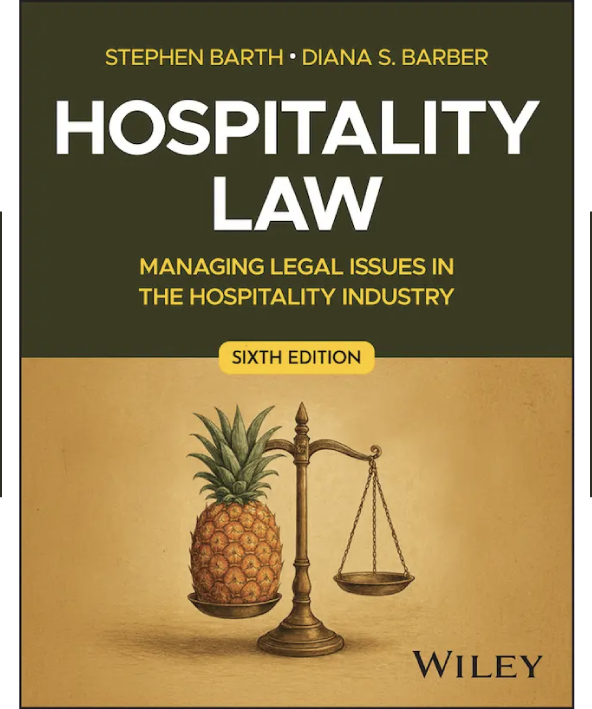
Hospitality Law: Managing Legal
Issues in the Hospitality Industry
Hospitality Law helps teach readers what they need to know to manage a facility legally, safely, and securely, taking an applied approach to the study of hospitality law with its touchstone of compliance and prevention. The legal information provided is carefully selected to specifically correlate with helping readers understand how to do the right thing.
H:
Hospitality Law
The body of law relating to the hospitality industry, governing provision of food, lodging, travel, and entertainment services to guests and clients.
Context: Combines elements of contract law, tort law, employment law, and regulatory compliance.
GRATUITOUS BAILMENT
Events that combine in-person attendance with virtual/remote participation, requiring compliance with technology agreements and hybrid liability coverage.
Context: Increasingly common post-pandemic; creates complex liability issues.
I:
Implied Warranty
An unwritten expectation that a product or service purchased is free of defects and fit for ordinary purposes.
Context: Applies to food service quality and guest room conditions.
Improvements
Additions to real estate that ordinarily enhance its value (e.g., renovations, new amenities).
Context: Hotel upgrades and restaurant remodeling.
Indemnification
To insure against possible liability and loss, and/or to compensate financially for losses already incurred; to make one whole.
Context: Indemnification clauses shift liability between contracting parties.
.
Independent Contractor
A person or entity contracting to perform a particular task whose work is not directed or controlled by the hiring party, and who may contract with others.
Context: Important distinction from employees for tax and liability purposes; controls hiring/firing/compensation.
INFLUENCER LIABILITY [UPDATED 2026]
Legal responsibility for sponsored content, endorsements, and affiliate marketing that may violate FTC regulations or constitute false advertising.
Context: Hotels using influencers for promotion must ensure FTC compliance and proper disclosures.
INFRA HOSPITUM
A Latin term meaning “within the hotel,” referring to obligations and duties within the hotel premises.
Context: Used in describing innkeeper liability standards.
IN-HOUSE DISPUTE RESOLUTION
A program funded by employers that encourages equitable settlement of employee claims prior to or without resorting to litigation.
Context: Mediation and ombudsperson programs reduce litigation costs.
Insure (Insurance)
To protect against specified risks through a contract with an insurance company.
Context: Essential risk management tool for hospitality businesses.
Insured
The individual or business that purchases insurance against a risk.
Context: The hospitality business is the insured in property and liability policies.
Insurer
The entity (insurance company) that provides insurance coverage in exchange for premiums.
Context: Responsible for paying covered claims.
INTANGIBLE PROPERTY
Personal property that cannot be held or touched, including patent rights, copyrights, and concept rights.
Context: Restaurant recipes, hotel loyalty programs, branded concepts.
Intellectual Property
Personal property created through the intellectual efforts of its owner, including patents, copyrights, trademarks, and trade secrets.
Context: Protects hospitality brands, concepts, and innovations.
Intentional Act
A willful action undertaken with or without full understanding of its consequences.
Context: Distinguishes from negligence; intentional acts may not be covered by insurance.
INTERDICTION PROGRAMS
Arrangements whereby citizens contact police to report suspected criminal activity before a crime is committed.
Context: Relevant to hospitality security and loss prevention.
Interrogatories
Written questions requiring sworn written answers, asked during the discovery phase of a lawsuit.
Context: Tool for gathering facts in hospitality litigation.
Interstate Commerce
Commercial trading or transportation of persons or property between or among states, regulated by federal law.
Context: Hotels and restaurants engaging in interstate commerce are subject to federal regulations.
Invitee
An individual on property at the expressed or implied consent of the owner, owed the highest duty of care.
Context: Paying guests are invitees; receive greater legal protection than trespassers.
J:
Job Description
A written, itemized listing of a specific job’s basic responsibilities, required skills, reporting relationships, and performance expectations.
Context: Essential for hiring, training, and establishing reasonable performance standards.
Job Qualification
The knowledge, skills, or certifications required to perform the responsibilities and tasks listed in a job description.
Context: Must be job-related and legally defensible.
Jurisdiction
The authority given by law to a court to hear cases and make decisions about legal matters within a geographic area and/or over certain types of cases.
Context: Determines which court system has authority over hospitality disputes.
L:
Landlord (Lessor)
The entity that owns property and leases it to a tenant under a lease agreement.
Context: Hotels may be lessors of properties or lessees to landlords.
Law
The rules of conduct and responsibility established and enforced by a society through governmental authority.
Context: Governs all hospitality business operations.
Lease
A contract establishing the rights and obligations of each party with respect to property owned by one entity but occupied or used by another.
Context: Governs restaurant locations, office space, and other commercial property use.
Lessor
The entity that owns the property covered in a lease and receives rent payments.
Context: Hotel or restaurant owner in a lease arrangement.
Liable
To be legally responsible or obligated; subject to payment of damages or other legal consequences.
Context: Hotels may be liable for guest injuries and employee conduct.
License
Legal permission to do a certain thing or operate in a certain way, granted by governmental authority.
Context: Liquor licenses, food service permits, operating licenses.
Licensee
One who is granted a license by the licensor.
Context: Individual or business holding operating or service licenses.
Licensor
One who grants a license to another party.
Context: Government agencies or brand owners granting licenses.
Lien
A claim against property giving a creditor the right to repossess and/or sell that property if the debtor fails to pay their debt.
Context: Hotels may place liens on guest property for unpaid bills.
LIMITED LIABILITY COMPANY (LLC)
A business organization protecting owners from liability for business debts without requiring formal incorporation, though some states tax LLC profits.
Context: Popular structure for hospitality businesses seeking liability protection.
LIMITED PARTNER
An entity in a limited partnership liable only to the extent of their investment, with no right to manage the partnership.
Context: Passive investors in hotel ventures.
LIMITED PARTNERSHIP
A business organization with two classes of owners: limited partners (investors with limited liability) and a general partner (managing partner with full liability).
Context: Used in some hospitality investment structures.
Liquor License
A permit issued by state/local authorities allowing the sale and/or service of alcoholic beverages; the holder is the licensee.
Context: Critical regulatory requirement for bars and restaurants.
Litigation
The act of initiating and carrying on a lawsuit; often used to refer to the lawsuit itself.
Context: Expensive process that hospitality businesses should seek to avoid.
Lost Property
Personal property that has been inadvertently put aside and then forgotten by the rightful owner.
Context: Hotels have procedures for handling guest lost property.
M:
MANAGEMENT AGREEMENT (MANAGEMENT CONTRACT)
A legal agreement defining the responsibilities and rights of a property owner and the management company operating the business.
Context: Common structure where management company operates hotel for owner.
MANAGEMENT COMPANY
An entity that, for a fee, assumes responsibility for the day-to-day operation of a hospitality business.
Context: Handles operations while owner retains ownership.
Maritime Law
Laws, regulations, international agreements, and treaties governing activities in navigable waters, including cruise ships and maritime transportation.
Context: Applies to cruise lines and water-based hospitality operations.
Master Bill (Master Folio)
A single bill established for a group that includes specifically agreed-on group charges, sometimes called group folio or group bill.
Context: Used in group billing for conferences and events.
Mediation
A dispute resolution process where an appointed, neutral third party (mediator) assists those in dispute with resolving differences. Successful results are called “settlements.”
Context: Less adversarial and expensive than litigation.
Medical Tourism [UPDATED 2026]
Travel by patients from one country/region to another for health care benefits and medical treatments, often combined with hospitality services.
Context: Growing market segment; creates unique liability considerations.
Meeting Planners
Professionals who plan and organize meetings and events for employers and clients, coordinating venues, catering, and logistics.
Context: Key customers for hotels and conference centers.
Merchantable
Suitable for buying and selling in ordinary commerce; meeting normal standards for such goods.
Context: Food and beverages must be merchantable.
Minimum Wage
The lowest amount of wages an employee covered by the Fair Labor Standards Act (FLSA) or state law may be paid by their employer.
Context: Hospitality minimum wage laws vary significantly by jurisdiction.
Mislaid Property
Personal property that has been put aside on purpose but then forgotten by the rightful owner.
Context: Distinguished from lost property; common in hotels and restaurants.
Mortgage
The pledging of real property by a debtor to a creditor to secure payment of a debt incurred to purchase the property.
Context: Used to finance hotel and restaurant properties.
N:
NEGLIGENCE PER SE
Violation of a rule of law by the operator; such violation is considered so far outside reasonable behavior that the violator is presumed negligent.
Context: Violating building codes or safety regulations may constitute negligence per se.
NEGLIGENT (NEGLIGENCE)
The failure to use reasonable care; conduct that falls below the standard of care a reasonably prudent person would exercise.
Context: Foundation of most hospitality liability claims.
NEGLIGENT HIRING
Failure by an employer to exercise reasonable care in selecting employees, particularly those in sensitive positions.
Context: Hiring someone with violent history for security position may constitute negligent hiring.
NEGLIGENT RETENTION
Failure to terminate an employee after the employer becomes aware the employee is a danger or threat to others.
Context: Continuing to employ a known harasser or danger exposes employer to liability.
NON-DISTURBANCE CLAUSE
A contract clause stipulating that leases or ownership investments in property will continue uninterrupted in the event of landlord default or insolvency.
Context: Protects tenants’ occupancy rights.
NON-DISTURBANCE CLAUSE
A confirmed reservation where no pre-payment or payment authorization is required; guest not charged if no-showing.
Context: Less common as cancellation protection for hotels.
O:
Off the Record
An oral agreement between a reporter and interviewee where the reporter promises not to quote the interviewee’s comments for publication.
Context: Management should be cautious in media interactions.
Offer
A proposal to perform an act or pay an amount which, if accepted, constitutes a legally valid contract.
Context: Hotels make offers when quoting rates; guests accept through booking.
OMBUDSPERSON
A company official appointed to investigate and resolve worker complaints in a neutral, independent manner.
Context: Helps prevent litigation by resolving employment disputes.
Operating Agreement
A contract detailing areas of responsibility of a business owner and the entity selected to operate the business, also called management contract.
Context: Governs relationship between owner and management company.
Operating Structure
The relationship between a business’s ownership and its day-to-day management.
Context: Key factor in determining liability allocation.
ORGANIZATIONAL STRUCTURE
The legal entity form that owns the business (sole proprietorship, partnership, corporation, LLC, etc.).
Context: Determines liability protection and tax treatment.
Overstay (Hangover)
A guest who refuses to vacate their room after exceeding the number of nights originally agreed to; also called a “hangover.”
Context: Hotels must follow proper eviction procedures for overstays.
OWNER OPERATOR (INDEPENDENT OPERATOR)
A type of operating structure where owners of a business are directly responsible for its day-to-day operation.
Context: Owner is fully liable for business operations.

Intelligent Emotions:
On Self Responsibility, Owning Our Emotional Power, and Changing Our Reactions:
Will you commit just one minute a day to changing your destiny? By taking ownership of your emotions, accepting responsibility for your reactions, and choosing positive responses over negative ones, you can unlock the path to emotional success.In this engaging and practical book, lawyer and motivational speaker Stephen Barth shares relatable stories and proven tools to help you build emotional intelligence and apply it in everyday life. Learn how to overcome stress, relationship challenges, and life's daily obstacles to find greater balance, happiness, peace, and productivity—both personally and professionally.
P:
Patent
A grant issued by a governmental entity ensuring an inventor the exclusive right to production and sale of their invention for a fixed period.
Context: Protects hospitality innovations and proprietary systems.
PCI-DSS (PAYMENT CARD INDUSTRY DATA SECURITY STANDARD) [UPDATED 2026]
International security standards requiring businesses handling credit card data to implement specific safeguards and security measures.
Context: Hotels must comply with PCI-DSS to accept credit cards safely.
Perfect A Lien
To make a public record of a lien or to take possession of collateral, perfecting the creditor’s security interest.
Context: Required to enforce liens against guest property.
Per Occurence
The maximum amount an insurer will pay in the event of a single claim or incident.
Context: Key limit to understand in liability insurance.
Personal Injury
Damage or harm inflicted upon the body, mind, or emotions of a person.
Context: Foundation of most hospitality liability claims.
Personal Property
Tangible and intangible items that are not real property, including movable goods and intellectual property.
Context: Guest luggage, restaurant equipment, intangible brand value.
Plaintiff
The person or entity who initiates litigation against another, sometimes called claimant, petitioner, or applicant.
Context: Injured guest becomes plaintiff suing hotel.
Policy (Insurance)
The contract for insurance agreed upon by an insurer and insured, detailing coverage, exclusions, limits, and conditions.
Context: Foundation of risk management for hospitality businesses.
POST TRAUMATIC STRESS DISORDER (PTSD)
A severe psychological reaction to an event that threatened an individual’s physical or emotional health, with lasting mental health effects.
Context: Can arise from workplace violence or traumatic incidents; may support liability claims.
Premium (Insurance)
The amount paid for insurance coverage; can be paid in lump sum or over time.
Context: Monthly or annual cost for insurance protection.
Press Release
An official announcement made by an organization or individual distributed for use by media.
Context: Hotels use for marketing; must be factually accurate to avoid defamation claims.
Primary Policy
The main insurance policy that provides basic coverage before umbrella or excess policies are triggered.
Context: First line of defense in multi-layer insurance structure.
Principal
The employer; the person hiring and directing employees (agents) to perform business duties.
Context: Hotel owner is principal; employees are agents.
PRIVACY POLICY (GDPR) [UPDATED 2026]
Legally required disclosure of how an organization collects, uses, and protects personal data, complying with GDPR and similar regulations.
Context: Hotels must disclose data practices and protect guest information.
Progressive Discipline
An employee development process providing increasingly severe consequences for continued violation of workplace rules.
Context: Documented progression supports termination decisions in litigation.
Proximate Cause
The event or activity that directly contributes to or causes injury or harm; the causal link between conduct and injury.
Context: Must establish proximate cause to succeed in negligence claims.
PUBLIC ACCOMMODATION
A facility providing entertainment, rooms, space, or seating for use by the general public, protected under ADA and civil rights laws.
Context: Hotels and restaurants are public accommodations with specific legal duties.
Public Domain
Property owned by all citizens collectively, not by private individuals, typically government-owned.
Context: Public parks and beaches.
PUNITIVE DAMAGES
A monetary amount awarded as punishment and to deter the same wrongful act in the future by the defendant and others.
Context: Available in egregious cases of gross negligence or intentional misconduct.
Q:
Quid pro quo
Latin term meaning “giving one thing in return or exchange for another”; mutual consideration in a transaction.
Context: Sexual harassment quid pro quo (job benefits for sexual favors) is illegal.
Quitclaim Deed
A deed that conveys only such rights as the grantor has, without guaranteeing title or defending against other claims.
Context: Provides less protection than warranty deed.
R:
Real Estate
Land, including soil and water, buildings, trees, crops, improvements, and rights to air above and minerals below.
Context: Hotel properties, restaurants, resort land.
Real Property
Land and all things permanently attached to it, including buildings and fixtures.
Context: Distinguished from personal property.
Reasonable Care
The degree of care that a reasonably prudent person would use in a similar situation; the standard against which negligence is measured.
Context: Foundation of hospitality duty of care obligations.
REPUTATION MANAGEMENT [UPDATED 2026]
Active monitoring and improvement of a business’s public image through online reviews, media relations, and crisis communication.
Context: Critical in hospitality where reputation directly affects bookings.
REIT (REAL ESTATE INVESTMENT TRUST)
A special business structure where owners are generally prohibited from operating the business directly, deriving income from real estate investments.
Context: Some hospitality properties organized as REITs.
RESPONDEAT SUPERIOR
Latin phrase meaning “Let the Master Respond”; a legal theory holding the employer (master) responsible for employee acts within course and scope of employment.
Context: Hotels liable for employee negligence and misconduct.
RIGHT OF FIRST REFUSAL
A clause in a contractual agreement where one party, upon relationship termination, can exercise the right to buy the other’s interest before it can be sold to third parties.
Context: May apply in partnership or franchise agreements.
S:
S CORPORATION
A type of business entity offering liability protection to owners while being exempt from corporate taxation on profits, with restrictions on formation.
Context: Alternative structure for some hospitality businesses.
SAFETY PROGRAM
Procedures and activities designed to ensure physical protection and good health of guests and employees, including training and emergency plans.
Context: Essential risk management requirement.
SECURITY AGREEMENT
A contract between lender and borrower stating the lender can repossess personal property offered as collateral if the loan is not paid as agreed.
Context: Governs equipment financing arrangements.
SECURITY Interest
A legal ownership right to property, allowing creditor to repossess if debtor defaults.
Context: Secured by UCC financing statements.
Segregate
To separate a group or individual on any basis, especially race, color, religion, or national origin.
Context: Illegal discrimination prohibited by civil rights laws.
Service Charge
An amount added to a guest’s bill in exchange for services provided (e.g., room service, event services).
Context: Must be clearly disclosed; applies differently than tips.
Service Marks
Similar to trademarks, legally registered words, names, symbols, or combinations indicating the source or producer of an organization’s services.
Context: Protects hotel and restaurant service branding.
Shares
Fractional portions of a company in which the owner has voting rights and rights to respective fraction of company assets.
Context: Used in corporate hospitality structures.
SHARING ECONOMY [UPDATED 2026]
An economic system where assets or services are shared between private individuals for a fee, typically via smartphone and Internet platforms.
Context: Impacts traditional hospitality; includes vacation rentals and room-sharing.
Signatory
An entity that signs and agrees to abide by the terms of a document.
Context: Each party to a contract becomes a signatory.
Small Claims Court
A court designed to hear lawsuits involving relatively small sums of money, providing speedy resolution without formal trial or attorney requirement.
Context: May be used for small hospitality disputes.
SOCIAL MEDIA DEFAMATION [UPDATED 2026]
False statements made via social media platforms that damage reputation, business, or earnings.
Context: Hotels must monitor and respond appropriately to false reviews and comments.
SOLE PROPRIETORSHIP
A business organization where one person owns and often operates the business, holding unlimited personal liability.
Context: Simple structure but high personal liability exposure.
Standard of Care
The industry-recognized, reasonably accepted level of performance used in fulfilling a duty of care.
Context: Establishes baseline expectations for hospitality operations.
STARE DECISIS
The legal principle of following prior case law decisions, maintaining consistency in judicial precedent.
Context: Prior hospitality law decisions guide current litigation.
STATUTE OF LIMITATIONS
Various laws setting maximum time periods within which lawsuits must be initiated; if not filed before expiration, courts cannot hear the case.
Context: Varies by state and claim type; ranges from 2-6 years typically.
Strict Liability
Responsibility arising from the nature of a dangerous activity rather than negligence or intentional act; also called absolute liability or liability without fault.
Context: May apply to certain hospitality hazards.
Sublet (Subleasing)
To rent property one possesses by a lease to another party.
Context: Restaurant or office space sublease.
Subpoena
A court-authorized order requiring a person to appear in person at a designated time and place or to produce evidence demanded by the court.
Context: Common in hospitality litigation for witness testimony.
SUSTAINABILITY/ESG [UPDATED 2026]
Environmental, Social, and Governance practices demonstrating corporate responsibility, increasingly required by investors and customers.
Context: Hospitality businesses must address climate, waste, labor practices.
T:
Tangible Property
Property that can be held or touched, including physical goods, real estate, and equipment.
Context: Distinguished from intangible property like patents.
Tariff
In airline industry, the agreement between airline and passengers. When purchasing a ticket, the passenger agrees to the tariff terms.
Context: Establishes carrier liability limits.
Tenant
Anyone, including a corporation, who rents real property for an extended period with intent to establish permanent occupation or residency.
Context: Distinguished from transient guest.
Third Party Liability
Liability for harm to parties other than direct contracting parties; focus areas include duties of hosts serving alcohol and licensed alcohol establishments.
Context: Basis for dram shop liability in hospitality.
Tip Party
The amount an employer is allowed to count toward minimum wage based on tips received, varying by state and applicable minimum wage laws.
Context: May allow employers to pay less than full minimum wage.
Tip Pooling/Sharing
An arrangement where service providers share their tips with each other on a pre-determined basis, subject to legal restrictions.
Context: Must comply with state tip pooling laws.
Tip (Gratuity)
A voluntary payment given in exchange for service performed, distinguished from service charges.
Context: Critical to hospitality worker compensation; subject to tax and labor laws.
Title
The sum total of all legally recognized rights to possession and ownership of property.
Context: Established through deed or other ownership document.
Title Search
A review of land records to determine ownership and description of a piece of real property.
Context: Required before purchasing hotel or restaurant property.
Trade Dress
A distinct visual image created for and identified with a specific product or service.
Context: Hotel décor, restaurant ambiance, brand presentation.
Trade Secrets
Business information not generally known that may provide competitive advantage, protected under state trade secret laws.
Context: Chef recipes, guest service procedures, pricing models.
Trademark
A word, name, symbol, or combination indicating the source or producer of an item.
Context: Protects hotel and restaurant brand names and logos.
Travel Law
Laws regulating business and individual behavior in the travel industry, including airlines, tours, and travel agents.
Context: Overlaps with hospitality law.
Truth-In-Menu Laws
Various laws and regulations implemented to ensure accuracy in menu wording, preventing misrepresentation of ingredients and preparation.
Context: Prevents false claims about food descriptions.
U:
Umbrella Insurance
Insurance coverage purchased to supplement primary coverage for additional protection above base policy limits; sometimes called excess insurance.
Context: Critical layer of protection for significant liability exposure.
Underwrite
To assume agreed-upon maximum levels of liability in the event of loss or damages.
Context: Insurance company underwrites risk.
Unemployment Benefits
Temporary monetary benefits paid to employees who involuntarily lose employment without just cause.
Context: Wrongful termination may result in unemployment compensation claims.
Unemployment Claim
A petition submitted by an unemployed worker to state unemployment agency asserting eligibility for unemployment benefits.
Context: Hotels must respond appropriately to minimize future premiums.
Unemployment Insurance
A program funded by employers providing temporary monetary benefits for employees who have lost their jobs.
Context: Mandatory coverage in all states.
UNIFORM COMMERCIAL CODE (UCC)
A model statute covering sales of goods, credit, bank transactions, and secured transactions, adopted in most U.S. states.
Context: Governs purchase of restaurant equipment and supplies.
V:
VICARIOUS LIABILITY
A party’s responsibility for acts of another resulting in injury, harm, or damage; closely related to respondeat superior.
Context: Hotels held vicariously liable for employee negligence and misconduct.
VIRTUAL EVENTS [UPDATED 2026]
Online events conducted entirely through digital platforms without in-person attendance.
Context: Create different liability and contractual considerations than in-person events.
W:
Warranty
A promise about a product made by manufacturer or seller that is part of the sales contract.
Context: Warranties on food quality and service.
Warranty Deed
A deed where the grantor agrees to defend the title from claims of others, representing full ownership and backing the title promise.
Context: Provides greater protection than quitclaim deed.
Warsaw Convention
The Convention for the Unification of Certain Rules Relating to International Carriage by Air (signed 1929) setting limits on airline liability for international flights.
Context: Relevant to international travel and airline liability.
WHISTLE-BLOWER PROTECTION ACTS
Laws protecting employees who have reported illegal employer acts from retaliation by that employer.
Context: Employees reporting safety violations are protected.
Worker Compensation
Benefits paid to employees who suffer work-related injury or illness, providing medical coverage and wage replacement.
Context: Mandatory in most states; insurance requirement for hospitality businesses.
WORKPLACE VIOLENCE [UPDATED 2026]
Acts of violence or threats occurring in or related to the workplace, creating liability for employers with inadequate security.
Context: Hotels must implement security measures and training.
Wrongful Termination
A violation by the employer of the employment relationship resulting in unlawful firing of the employee in breach of contract or law.
Context: Illegal terminations expose employers to significant liability.